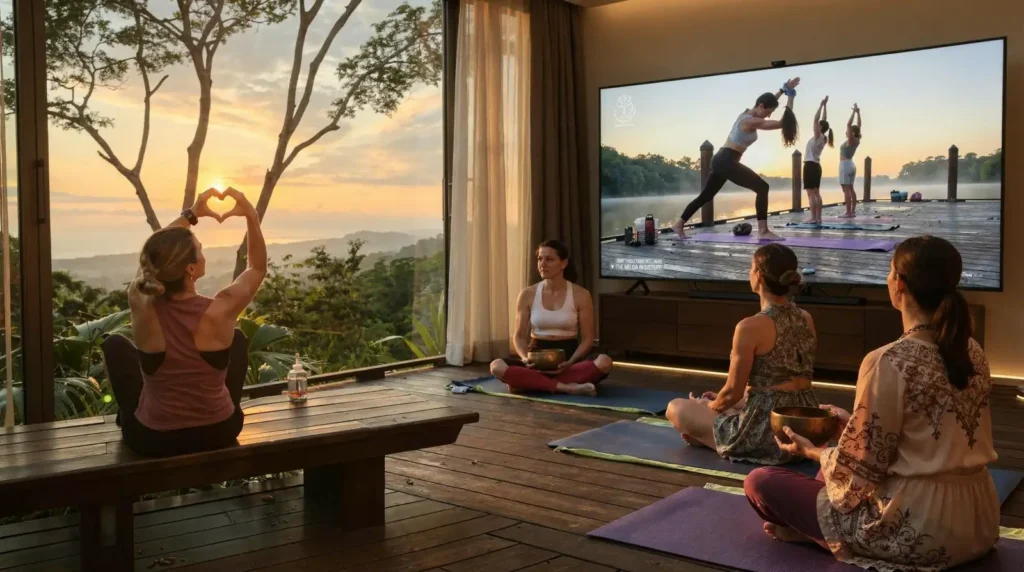
When it comes to online vs in-person yoga, online yoga offers convenience and flexibility, letting busy schedules fit practice into any moment at home. In-person classes, like those at Lost Art Yoga, deliver hands-on adjustments, real-time energy, and genuine community connection. We believe true transformation often blossoms fastest through shared presence, breath, and the soulful accountability studio spaces naturally inspire.
Key Takeaways
- Online yoga classes eliminate commute time and offer flexibility for busy schedules without leaving home.
- In-person instruction provides direct alignment corrections and personalized feedback that online classes cannot fully replicate.
- COVID-19 pandemic drove unprecedented numbers of yogis to online alternatives like DoYogaWithMe for accessible instruction.
- Hybrid models combine both formats, allowing yoga teachers to maintain studios while expanding their student reach online.
What’s Really Different Between Online and In-Person Yoga?
Screens change the experience, but they don’t erase the essence of practice. Commercialization has flooded the wellness world with quick-fix apps. Trendy studios, leaving many beginners unsure what authentic yoga even looks like anymore. We built Lost Art Yoga to cut through that noise, whether we’re guiding you through a mat-side adjustment or meeting you through a laptop screen.
The honest comparison of online vs in-person yoga comes down to what each format gives your body and your spirit. Studio classes offer something screens can’t fully replicate: hands-on adjustments, the shared breath of a room, and a teacher who can see your alignment from every angle. That spatial awareness matters, especially for beginners learning to trust a new posture.
Virtual yoga classes, meanwhile, meet you in the middle of a busy week. They widen access for people juggling work travel, childcare, or unpredictable schedules. Surprisingly, home practice often builds stronger self-reliance — you learn to listen to your own body without waiting for outside cues.
Is online yoga as effective as studio classes?
Effectiveness depends on your goals. For refining alignment or working through injury, studio yoga classes offer real-time correction that online formats can’t match. For building consistency and independence, a home practice holds its own.
Which format feels more authentic?
Authenticity lives in the teaching, not the platform. We maintain consistent brand identification across every offering. The depth, lineage, and intention behind our instruction stay the same whether you’re on our studio floor or joining us online. The format shifts; the truth of the practice doesn’t.
Can Virtual Yoga Classes Replace the Studio?
Yes, for many practitioners — genuinely and satisfyingly so. We believe the honest answer to online vs in-person yoga isn’t either-or, but rather a question of what season of life we’re in. Busy weeks call for different support than open ones, and both paths lead somewhere real.
Virtual yoga classes meet us exactly where we stand — literally. No commute, no rushing to beat the studio door closing. For a parent juggling bedtime routines or a professional squeezing practice between meetings, that flexibility isn’t a small convenience. It’s the difference between practicing consistently and not practicing at all.
Cost matters too. Studio yoga classes often carry membership fees that feel steep when we’re still deciding if a regular practice fits our life. Online platforms typically offer tiered access, sometimes free, letting curious beginners test the waters before committing financially.
Is Online Yoga as Effective as In-Person Classes?
Effectiveness depends on what we’re seeking. For building a home practice, deepening breathwork, or simply moving daily, virtual classes deliver real, lasting benefit. What they can’t replicate is a teacher’s hands guiding alignment or the collective energy of bodies breathing together in one room.
Should Beginners Start Online or in a Studio?
Either entry point works beautifully. We often encourage newcomers to start online, low-pressure and private, then bring that foundation into a studio once confidence builds. The reverse works too.
At Lost Art Yoga, we hold both spaces as sacred. Consistent brand identification across our virtual and in-person offerings means the same soulful guidance meets you wherever you choose to unroll your mat.
What Does In-Person Studio Practice Offer That’s Different?
Shared space changes how we practice. Community energy fills a room in ways no screen replicates. When we weigh online vs in-person yoga, the studio brings something a solo living-room session simply cannot: bodies moving together, breath syncing across a room, a teacher who can see exactly where our hips are stuck.
Studio yoga classes also open the door to real variety. In a city like Richmond, studios typically offer Vinyasa, Hatha, Yin, and Hot Yoga under one roof, each style asking something different of the body. We often guide beginners toward Hatha first, since it builds foundational poses at a manageable pace. Vinyasa suits anyone craving cardio-flow intensity, while Yin invites deep stretching and stress relief through slower, longer-held postures.
Which studio class should a beginner try first?
Local studios welcome newcomers into a full schedule rather than a single entry point. That range might include an energizing hot flow class on one end and a restorative, unwind-style session on the other. We encourage beginners to sample a few formats before committing to one path.
Do I have to pick the “right” style before walking in?
No — one class tends to answer the only question that actually matters. Does this practice, this teacher, this room feel right in the body? That felt sense rarely comes through virtual yoga classes, where cues arrive through a speaker instead of a shared breath.
We built Lost Art Yoga around that in-person discovery, believing presence and community remain irreplaceable parts of the practice.
Is a Hybrid Approach the Best of Both Worlds?
Blending both worlds gives most practitioners the strongest, most sustainable path forward. We’ve watched students thrive when they stop choosing sides. Start weaving online vs in-person yoga into one flexible rhythm instead.
At Lost Art Yoga, we see this pattern constantly. Busy weeks call for a laptop and a living room floor. Quieter ones call for community, touch, and the shared breath of a real room. Neither option has to lose — they simply take turns.
How do virtual and studio practice work together?
Virtual yoga classes fill the gaps that life inevitably creates — early meetings, sick kids, travel, exhaustion. They keep the practice alive when a studio visit isn’t realistic. But studio yoga classes offer something a screen can’t replicate: hands-on adjustment, collective energy, and the accountability of showing up alongside others.
We’ve found the healthiest rhythm looks something like this:
- Weekdays: short virtual sessions to maintain consistency
- Weekends or evenings: in-studio classes for connection and correction
- Retreats or immersive weekends: deeper resets for nervous system and mindset work
Why does immersive, in-person practice matter so much?
Full-body, in-person immersion — whether a weekend retreat or a dedicated studio session — creates change that lingers. Research on mindfulness immersions and nature-based retreats links this kind of practice to measurable shifts in mood, brain structure, hormone balance, immune response, and even decision-making, with effects that can last for months.
We didn’t build Lost Art Yoga to choose one modality over another. We built it to help students return to something authentic, whatever the setting. Because that return, online or in person, is where real transformation begins.
How Should You Choose Between Online and Studio Yoga?
Weighing online vs in-person yoga starts with an honest question: why did the practice begin in the first place? Many practitioners reach a moment of realizing they’ve been moving too fast to remember that original reason. A clear sign the current rhythm needs a second look.
Virtual yoga classes answer convenience. A laptop, a living room, ten free minutes between meetings — practice fits wherever life allows. But convenience alone doesn’t always rebuild what got lost along the way.
Studio yoga classes answer something different: presence, breath shared in a room, eyes that notice when we’re struggling. In a culture that treats constant productivity as a virtue, choosing to step away and show up in person can feel indulgent, even irresponsible. That discomfort is often the exact signal worth listening to.
A community studio also builds consistent brand identification. One place, one lineage, one gateway into deeper offerings like private sessions, soundbaths, retreats, and workshops that a single class can’t fully capture.
Is online yoga as effective as studio yoga for beginners?
Effectiveness depends on what beginners are chasing. For flexibility and low-pressure exposure, screens work well. For accountability, correction, and the felt sense of not practicing alone, studio floors tend to hold more.
Can returning practitioners rebuild community through virtual classes alone?
Rarely on their own. Virtual sessions maintain a habit, but the deeper reconnection — the kind that follows retreats, workshops, and soundbaths — usually starts with walking back through a studio door.
FAQ
What is the main difference between online and in-person yoga?
In-person classes offer hands-on adjustments, real-time energy, and shared community presence. Online yoga provides flexibility and convenience for practicing at home without a commute.
Is online yoga as effective as in-person classes?
Effectiveness depends on your goals. Studio classes give real-time alignment correction that benefits beginners and injury recovery, while home practice builds consistency and self-reliance.
Can online yoga classes replace studio classes entirely?
Yes, for many practitioners, depending on their season of life. Online classes remove commute time and offer tiered access, making consistent practice possible for busy schedules.
Conclusion
In closing, the choice between online and in-person yoga isn’t about one being superior—it’s about honoring what your body, mind, and life require right now. In-person classes offer the irreplaceable gift of community, hands-on guidance, and energetic presence. Online practice brings accessibility and flexibility to your mat at home. The truest practice is the one you’ll actually show up for, the one that meets you where you are and invites you deeper into yourself. Both paths lead home.
